
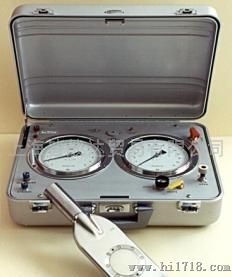
dilatometerDMTDMT and SDMT
价格:电议
地区:
电 话:86-021-56358494
传 真:0086-021-56356034
图文详情
产品属性
相关推荐
Abstract: A dilatometer test consists of pushing a flat blade located at the end of a series of rods. Once at the testing depth, a circular steel membrane located on one side of the blade is expanded horizontally into the soil. The pressure is recorded at specific moments during the test. The blade is then advanced to the next test depth.
The main application of the DMT is to estimate Settlements and Operative Moduli, both in sands and clays, and the undrained shear strength in clay.
Other design applications include: compaction control, detecting slip surfaces in slopes, liquefiability, laterally loaded piles and other geotechnical problems using the soil parameters for which the instrument provides estimates.
Often DMT is requested by engineers in jobs where accurate predictions of settlements of foundations are needed or when a decision has to be taken about adopting a shallow or a deep foundation.
Role of
the DMT:
The most critical ingredients for a correct geotechnical design are, as today,
the input soil parameters (we have plentiful "precise" computer
programs).
Considering the disillusionment with "undisturbed" soil samples &
laboratory testing (costly, uncertain quality, few data, time), the trend in
the last decades has been towards in situ testing, that is often today the
major portion of a geotechnical investigation (e.g. Schmertmann 1995, Powell
2001).
According to many eminent scientists (see e.g. State of the Art at the last
Geotechnical World Conference 2009), the most practical and fast in situ tests
- for everyday design - are CPT and DMT, the other methods being considered by
these scientists too costly or complicated or slow.
CPT is faster than DMT, hence in many cases it is preferable and sufficient.
However, in the frequent case that the design requires accurate settlement
predictions, CPT may be not sufficient, as CPT often provides inaccurate
settlement estimates (e.g. Robertson 1986, Leonards
1988, Jamiolkowski 1988, Schnaid 2009) and therefore DMT data, predicting well settlements, become preferable. DMT is also
considerably more sensitive to stress history, which dominates soil behaviour
(e.g. stress history is important for deformation analysis, for liquefaction
evaluations etc.). The higher sensitivity to stress history is also the reason
why DMT monitors the benefits of compaction twice as sensitively as CPT.
The DMT blade is also considerably more sensitive to horizontal stresses. Due
to the flat shape, arching is negligible, as opposite to axi-symmetric probes,
where arching obscures the horizontal stress.
Distinctive features of DMT:
Soil distortions. The dilatometer distorts the soil
substantially less than other penetration tests.
Deformation properties. DMT measures the pressure causing a given soil
displacement (a mini load-test). Hence DMT results are closer to moduli than
tests providing soil rupture data.
DMT is a genuine two-parameter test, one of which, Kd, is closely correlated
to Stress History, a parameter having a substantial influence on Settlements
and Resistance to Liquefaction.
Arching effect. The penetration of cylindrical probes creates a stiff
soil ring surrounding the probe (Robertson & Hughes 1995). Such obstacle/parasitic
screen reduces the sensitivity to Sigma h (Huang 1994). The arching effect is
nearly nonexisting with the DMT flat blade (L/B ratio = 7), resulting in a
higher sensitivity to Sigma h.
Compaction control. The DMT has been found to be about twice as
sensitive to compaction as other penetration tests (e.g. Schmertmann 1986,
Jendeby 1992, Pasqualini 1993, De Cock-Van Impe-Peiffer 1993).
.
DMT and SDMT:
Cape Kennedy Space
Center
Rome Metro underground
San Andreas Fault area
Nearshore Investigations by DMT
Score table of various in-situ
test